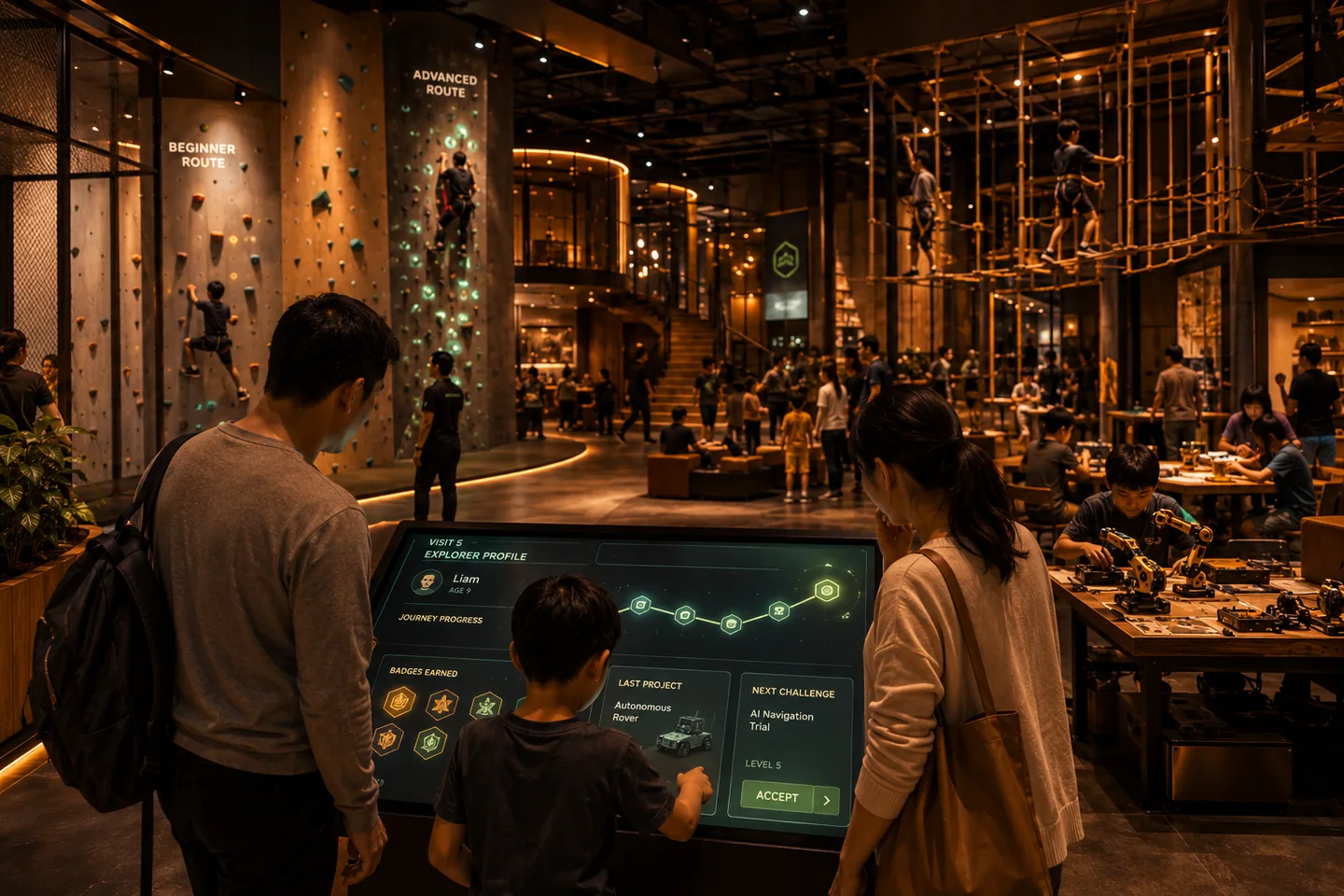
A child may visit the same family entertainment park five or ten times, yet in many traditional FECs every visit effectively begins from zero. The park may know when the family visited and what they purchased, but it often knows very little about what the child completed, enjoyed, created, practiced, or became better at during earlier visits. This creates what the FEC Gap Taxonomy describes as the Progression Gap: the absence of a meaningful connection between one visit and the next.
Repetition is not the same as progression. A child can climb the same structure repeatedly, jump on the same trampoline, or play the same game many times, but the experience becomes much more durable when there is a visible next step. A beginner climbing route can lead to a more advanced one. An obstacle challenge can become faster, more complex, or more collaborative. A first robotics activity can develop into a longer-term project. A child interested in storytelling, sports, design, science, or business can gradually follow a different path from another visitor. The physical environment may remain largely the same while the experience continues to develop.
Progression is important because familiarity can otherwise turn into boredom. Once children understand what an attraction does and feel that they have already mastered it, the reason to return becomes weaker. Progression changes that relationship. Familiarity becomes the foundation for greater difficulty, competence, autonomy, and mastery rather than the end of the experience. The child is no longer simply repeating an attraction; the child is continuing a journey.
This has major implications for memberships. Unlimited access to static attractions can provide financial value, but it does not automatically create strong emotional or developmental value. A stronger membership model can include levels, saved projects, recurring missions, clubs, competitions, personal records, achievements, recommendations, and next challenges. The value of membership then shifts from access to repetition toward access to progression.
Persistent identity can make this system even stronger. A park can remember previous achievements, interests, projects, and preferred activities so that the next visit does not start from the beginning. This does not require every experience to become highly digital. Progression can be managed through simple challenge cards, levels, portfolios, staff recognition, club participation, physical badges, or more advanced digital profiles. The important principle is continuity: visit five should be able to build meaningfully on visits one through four.
Progression also strengthens the parent side of the experience. Parents may have difficulty seeing the value of repeated visits when every visit appears to be two more hours of the same play. The value becomes easier to recognize when they can see that a child completed a more difficult challenge, improved a time, built a larger project, learned a new skill, contributed to a team, or prepared something to present. Visible progress can therefore support both child enthusiasm and parent approval, strengthening the dual-loyalty relationship that is so important in family entertainment.
For operators, the strategic question is simple: Is visit five meaningfully different from visit one? If the answer is no, the park may be selling repeated access without creating a progressively richer experience. Family entertainment parks of the future should be designed so that children can return not merely because they enjoyed what happened last time, but because there is something unfinished, something more difficult, something new to create, or a clear next level waiting for them.
Key points
- Repetition and progression are different: repeat use becomes more valuable when there is a meaningful next step.
- Challenges, difficulty, responsibilities, and projects can evolve as children improve.
- Persistent identity can connect one visit to the next through saved progress, achievements, interests, and recommendations.
- Progression can reduce novelty decay by turning familiarity into mastery.
- Memberships become stronger when they provide access to an evolving journey rather than only discounted repeat entry.
- Visible achievements help parents understand the developmental and experiential value of frequent visits.
- A useful operating test is: Can visit five be more advanced and more personally relevant than visit one?
By Dr. Maksim Godovykh