SCIENCE OF PLAY

The Neuroscience of Play: Why Children Climb, Jump, Slide, Explore, and Repeat

Why are children naturally attracted to climbing, jumping, slides, obstacles, exploration, and repetition? Developmental science helps explain why physical play is so powerful—and how family entertainment parks can make it even more valuable.

Read the original article in PDFReturn to Research Library
The Neuroscience of Play: Why Children Climb, Jump, Slide, Explore, and Repeat — Future Experience Research

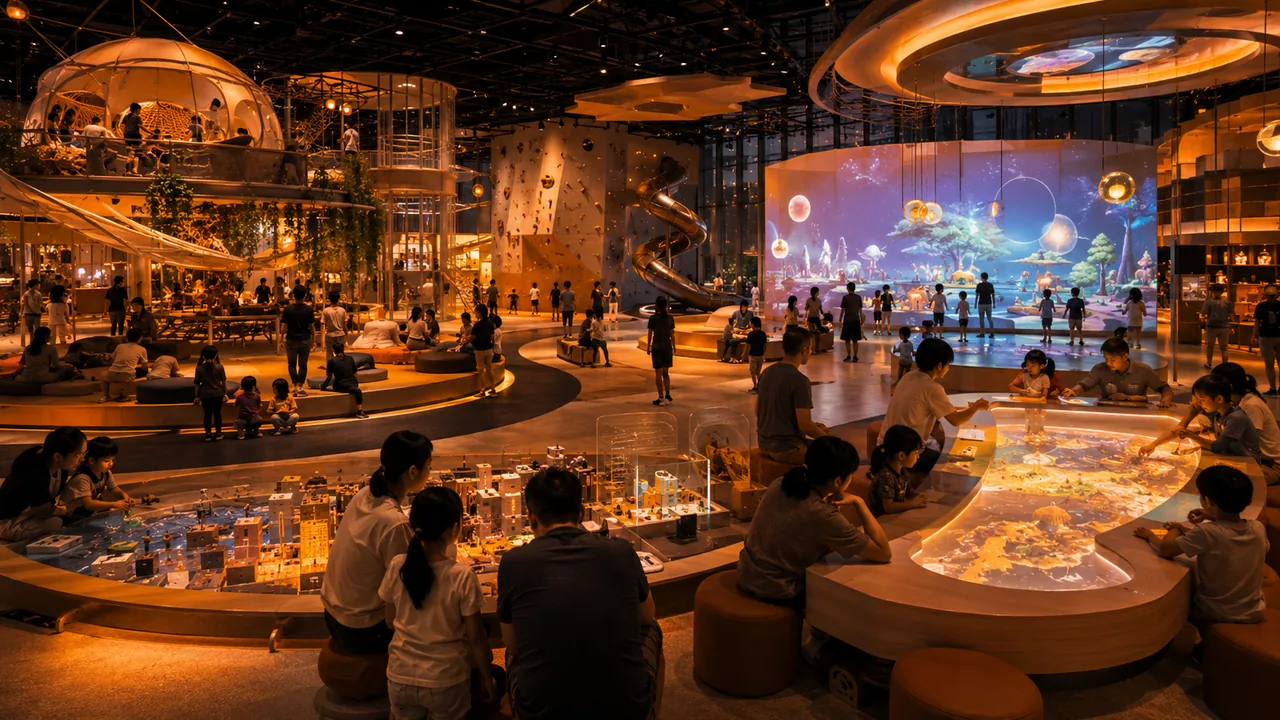
Children climb, jump, slide, balance, explore, and repeat not because of one simple brain mechanism, but because active play combines sensory, motor, cognitive, emotional, and social processes.

A climbing route, for example, asks a child to judge distance, select holds, distribute body weight, plan the next move, correct mistakes, and manage the uncertainty associated with height or difficulty. Movement and thinking happen together.

This is why the developmental value of a physical attraction depends on how it is designed. The same wall can be a one-time physical activity or a long-term system of routes, levels, timed challenges, cooperative tasks, problem-solving missions, and visible mastery.

Age matters as well. Younger children often learn through sensory-motor exploration, cause and effect, movement, and pretend play. School-age children increasingly value rules, competence, strategy, and peer comparison. Preteens and teens can engage with more complex goals, identity, collaboration, leadership, and real-world relevance.

The implication for FEC design is not simply to make equipment larger as children grow. The cognitive and social structure of the experience should become more advanced too.

Jumping, balancing, obstacle play, loose parts, active games, and interactive movement systems can all become richer when they include choice, planning, progressive difficulty, problem solving, communication, and feedback.

This also helps explain why physical play remains important in increasingly digital family environments. Technology can support scoring, changing missions, personalization, or feedback while the child remains physically and socially active.

The strongest direction is not to replace play with educational content. It is to understand what children are perceiving, deciding, coordinating, remembering, regulating, and communicating while they are having fun.

Physical activity becomes more durable when children can progress from initial discovery toward competence, mastery, social challenge, and new goals across repeated visits.

Read the original article in PDFReturn to Research Library
FEC GAPS

What Existing FECs Leave Unresolved.

Our FEC Gap Taxonomy identifies recurring weaknesses across traditional family entertainment. These six structural gaps are especially important to repeat visitation, family value and long-term engagement.

01

Novelty & Repeat Visitation

Static attractions lose novelty. Changing themes, missions, programs, levels and events create new reasons to return.

02

Personalization & Progression

The same experience for every child limits relevance. Profiles, interests, recommendations, saved projects and levels make later visits more personal.

03

Social Connection

Activity without belonging is easy to replace. Clubs, teams, competitions and community programming create social reasons to return.

04

Parent & Whole-Family Value

Parents too often wait, supervise and pay. Better concepts let adults relax, work, observe, connect, participate and understand the value.

05

Developmental Value

Entertainment can do more than occupy time. Movement, thinking, creativity, problem-solving and visible outcomes can be embedded in play.

06

Technology & Digital Continuity

Technology should support creation, personalization, feedback and continuity — not simply add more passive screen time.

HOW THE RESEARCH WORKS

Research Through Real Questions, Prototypes and Evidence.

We move from identifying a problem to testing a practical response, observing what families and markets actually do, and improving the strategy based on evidence.

01

Identify the Gap

Define a recurring weakness, unmet need, market question or operating problem.

02

Build a Hypothesis

Describe what change may create a better customer, market or business outcome.

03

Design the Test

Turn the hypothesis into a prototype, research design or practical experiment.

04

Observe & Measure

Study behavior, feedback, engagement, demand and other relevant outcomes.

05

Interpret

Compare what happened with what was expected and identify what matters.

06

Improve

Refine the concept, strategy or operating model and repeat the cycle.

CONTACT

Conduct Research.
Develop Strategy.
Make It Better.

Improving an existing FEC, developing a new activity park, revitalizing a shopping mall, developing multifamily housing, evaluating a market, or testing a new concept? Let's discuss.