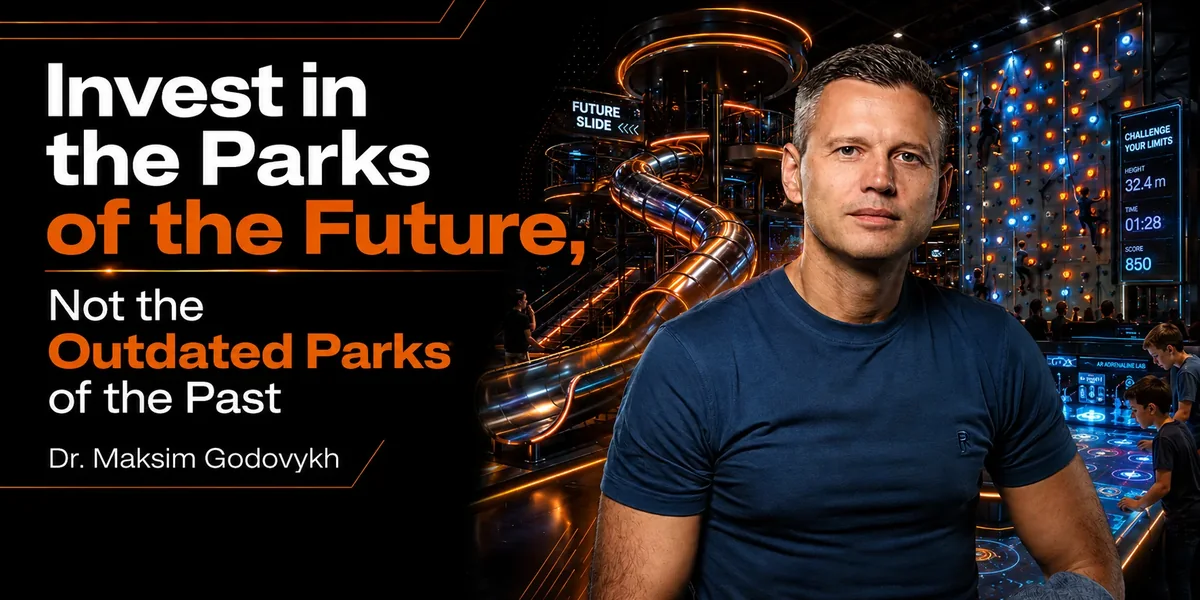
Over the past year, we have studied the limitations of traditional family entertainment parks and activity parks from several different perspectives: customer experience, child development, neuroscience, behavioral economics, family decision-making, attraction economics, operations, programming, and experience design. The conclusion is increasingly clear. The industry does not primarily suffer from a shortage of attractions. It suffers from a shortage of systems that make attractions remain valuable over time. A park can open with impressive trampolines, climbing structures, slides, arcades, ropes courses, and interactive equipment and still become repetitive after several visits. The next generation of family entertainment should therefore be designed not as a static collection of equipment, but as an adaptive family experience platform that can evolve together with its visitors.
One of the most important problems is novelty decay. A physical attraction may remain mechanically useful for many years while its psychological value declines much sooner. Children quickly learn what a slide does, which route they prefer, what happens inside an obstacle course, or how an interactive game works. The solution cannot be to replace expensive equipment every time familiarity increases. Parks of the future should create experiential novelty around existing assets through new missions, rules, levels, stories, team challenges, tournaments, seasonal overlays, rewards, and changing content. A climbing wall does not have to change physically every month if the challenge changes. A trampoline court does not have to be rebuilt if visitors can encounter new games, targets, competitions, and levels. The investment opportunity is therefore not only in physical attractions, but in the programming and experience systems that reduce psychological depreciation of those assets.
The same principle applies to personalization and progression. Most traditional parks treat every visit almost as if it were the first one. A six-year-old and a twelve-year-old may use the same environment differently, but the park itself rarely remembers their interests, abilities, previous accomplishments, or changing skills. Future parks can create persistent profiles, saved projects, adaptive difficulty, recommendations, personal records, achievements, and next challenges. Visit five should have the possibility of being more advanced and personally relevant than visit one. This changes membership economics as well. A membership should not simply mean discounted access to the same experience; it should mean access to an evolving journey in which children continue developing, mastering, creating, and discovering something new.
Another major weakness of traditional family entertainment is that parents are frequently treated as payers and supervisors rather than customers. Comfortable seating, Wi-Fi, charging, good coffee, better food, clear sightlines, and quieter areas matter because waiting is part of the experience. But simply creating a nicer waiting lounge is not enough. Parents should be able to choose whether to relax, work, observe, socialize, participate, or create something together with their children. This connects directly to what we have described as the Dual-Loyalty Model: a successful family entertainment park must generate both child enthusiasm and parent approval. Children may judge the park through fun, challenge, autonomy, friends, novelty, and mastery, while parents evaluate safety, cleanliness, convenience, value, food, comfort, and developmental benefit. Sustainable repeat visitation becomes much stronger when the child wants to come back and the parent independently believes that coming back is worthwhile.
The parks of the future should also create substantially more developmental value without turning entertainment into school. Children already learn through movement, play, experimentation, repetition, social interaction, and challenge. Climbing can involve route planning, judgment, persistence, and controlled risk. Trampoline activities can combine movement with reaction, memory, strategy, and teamwork. Creator stations can develop imagination, communication, design, problem-solving, and entrepreneurship. Group missions can require collaboration and leadership. Children can create games, books, videos, robots, designs, businesses, inventions, and presentations while still experiencing the park primarily as entertainment. The opportunity is to move beyond simply keeping children occupied and toward environments where they can move, explore, create, develop skills, collaborate, present, and progress.
This also requires moving beyond the traditional equipment-centered layout. Many activity parks are still designed by fitting as many attractions as possible into a box and then adding circulation, seating, food, and party rooms around them. A stronger park begins with the customer journey. Families anticipate the visit, arrive, orient themselves, explore, become active, encounter challenges, experience mastery, recover, reconnect, create, celebrate, form memories, and decide whether there is a reason to return. Attractions should support this sequence rather than exist as disconnected islands. High-intensity physical activity can be balanced with lower-intensity exploration and creation. Individual play can alternate with social and family experiences. Storytelling can connect different zones without requiring expensive themed construction. Equipment is infrastructure; the journey is the experience.
Programming and technology should become equally important parts of the operating model. Parks cannot rely only on open play and birthday parties if they expect families to visit frequently. Weekly clubs, competitions, workshops, family challenges, school programs, exhibitions, creator showcases, monthly themes, seasonal missions, and major annual events can continuously refresh the experienced product without rebuilding the physical venue. Technology should support this system rather than simply adding more screens. AI, interactive environments, profiles, wristbands, digital portfolios, and responsive attractions become meaningful when they increase agency, personalization, creation, progression, and continuity. A screen that children passively watch adds little to the future of family entertainment; a system that allows them to design something, test it, improve it, and continue it during the next visit is fundamentally different.
For investors, developers, operators, and landlords, this leads to a broader question than which attraction category is currently popular. The strongest future concepts should be evaluated by how well they manage repeatability, parent value, developmental depth, programming, customer journey, operating flexibility, technology, community connection, and capital productivity. New ideas can increasingly be tested through temporary programs, pop-ups, smaller-format concepts, and live experiments before committing to expensive permanent construction. Parks themselves can operate as living laboratories—testing new missions, layouts, programs, memberships, food concepts, parent spaces, and attraction layers and measuring how families actually respond. This is the moment to invest not in recreating the family entertainment parks developed twenty years ago with newer equipment, but in building a new generation of places that can continuously adapt. The parks of the future will not simply contain more attractions. They will create better experiences, stronger family relationships, deeper developmental value, more reasons to return, and more durable economics.