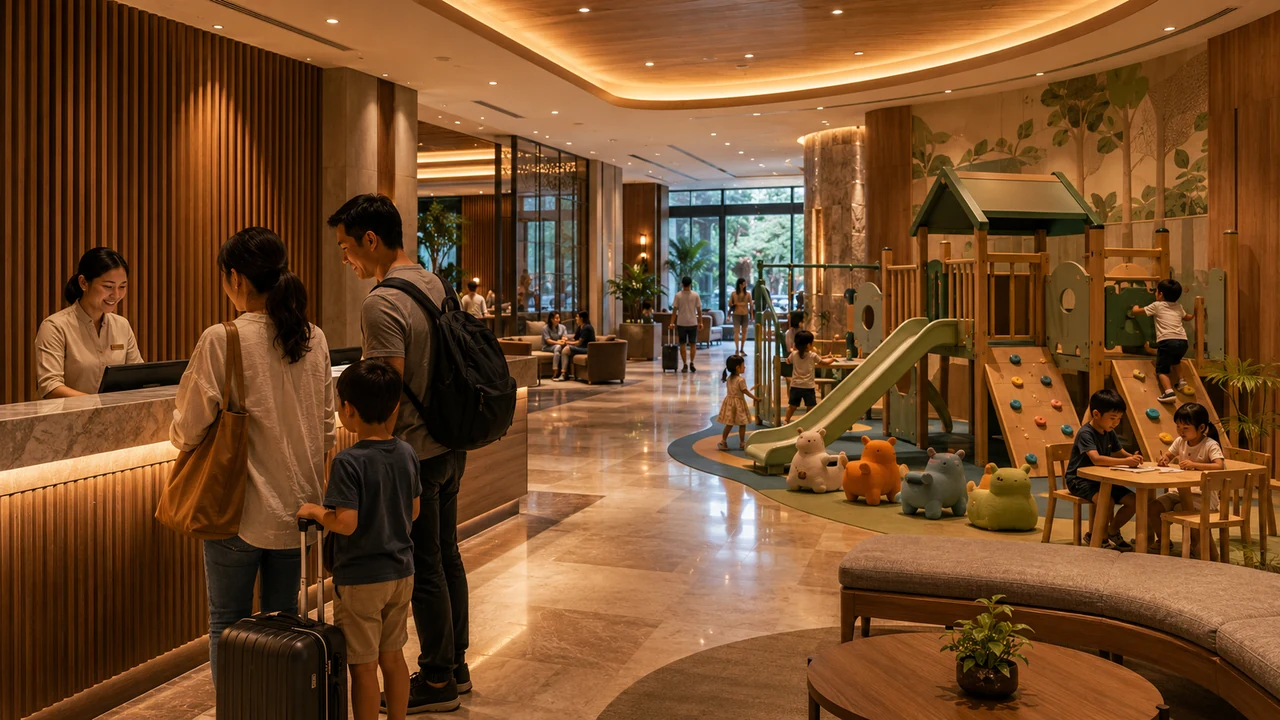
Families are one of the most important hospitality segments, but they experience hotels differently from individual travelers or couples. A comfortable room, good breakfast, convenient location, and friendly service remain essential, yet parents are also judging whether their children are safe, comfortable, entertained, engaged, and happy—and whether the hotel makes the entire family trip easier.
A family-friendly hotel is therefore not simply a hotel that allows children. It is a hotel that intentionally designs the experience of the whole family. Research on customer experience, family travel, hospitality satisfaction, emotions, and loyalty suggests a connected pathway: child-friendly amenities and experiences can increase child enjoyment and engagement, which can support parent relaxation and shared family satisfaction, strengthen positive emotions and memories, and ultimately contribute to recommendations, positive reviews, revisit intentions, and loyalty.
This does not mean that installing a playground automatically increases occupancy or revenue. Family-friendly solutions create the most value when they are integrated into the overall hotel experience and respond to the needs of both children and parents.
Families Choose Hotels Differently
Families consider a broader combination of functional and experiential attributes when selecting accommodation. Cleanliness, value, safety, location, and room configuration remain fundamental, but children's amenities can become meaningful differentiators once these basic expectations are satisfied. In the 2025 U.S. Family Travel Survey, 48% of parents considered children's amenities—including pools, beaches, game rooms, and kids' clubs—important when choosing accommodation. This was higher than the 30% who selected adult amenities and more than three times the 14% who identified loyalty to a particular accommodation brand as important (Family Travel Association et al., 2025).
Children also increasingly influence travel decisions themselves. Seventy percent of travelers with children reported choosing vacation destinations based on children's needs and interests, while 56% indicated that kids' clubs and youth programming could influence hotel selection (Hilton, 2024). Children should therefore not be treated merely as accompanying guests. They are part of the hotel-selection process. When two properties are similarly located and similarly priced, an attractive playground, kids' club, family program, interactive experience, or distinctive children's space can become the deciding factor.
The Child's Experience Shapes the Parent's Experience
Family hospitality is unusual because satisfaction is not completely individual. Parents evaluate a vacation partly through what happens to their children, and shared family satisfaction can significantly influence parents' own satisfaction with the trip (Rojas-de-Gracia & Alarcón-Urbistondo, 2020). A parent may have a comfortable room and excellent service, but if the child is bored or unhappy, the trip may still feel unsuccessful. The opposite is also true: when children are engaged, safe, and enjoying themselves, parents can relax and the child's enjoyment becomes part of the parent's positive experience.
Activities and family cohesion contribute to overall vacation satisfaction (Gregory & Fu, 2018). Family vacations can support bonding, communication, and solidarity, while important functions of family travel include shared time, relaxation, learning, novelty, and connection (Fu et al., 2014; Lehto et al., 2009). The strategic question for a hotel is therefore broader than “What can children do here?” A stronger question is: “How can the hotel make the entire family experience better?”
Family-Friendly Hospitality Is a System, Not a Checklist
Research across family-travel markets consistently points to several connected needs: child-friendly amenities, safety, quality interactions, family-oriented programming, convenient facilities, and experiences that children genuinely enjoy (Khoo-Lattimore et al., 2015; Khoo-Lattimore et al., 2018). Contemporary research on child-friendly hotels similarly emphasizes service quality, children's activities, food variety and quality, room comfort and cleanliness, and safety and accessibility (Çiki, 2026).
These elements work together. A playground is more useful when parents have comfortable seating nearby. A kids' club becomes more valuable when parents trust its supervision. A children's menu works better when family dining is easy. A family room solves sleeping logistics, but the hotel becomes more memorable when the family also has something meaningful to experience together. Family friendliness should therefore be designed as a system of experiences and services, not a label attached to a list of amenities.
There Is Still a Gap Between Family Expectations and Hotel Offerings
Many conventional hotels, especially urban properties, still offer relatively limited children's facilities even when family travel represents meaningful demand. Parents place high importance on indoor playrooms and outdoor playgrounds, yet these amenities remain uncommon in many city hotels (Siwek et al., 2022). This creates an opportunity for properties that can convert underused space into visible family value.
The investment does not always need to be large. A compact indoor playroom, small playground, interactive wall, creative corner, climbing feature, discovery area, game space, or scheduled family activity can materially change the stay. Lobby zones, terraces, courtyards, meeting rooms during off-peak periods, and underperforming retail areas can all become candidates for family-oriented use when the location, supervision, and operating model are appropriate.
Move From a Playground to a Family Experience System
The best starting point is usually practical family convenience: suitable room configurations, cribs and children's beds, connecting rooms, child-friendly dining, highchairs, changing facilities, stroller accessibility, safe common areas, and clear information about children's services. These features are not exciting, but they reduce friction and create the foundation for satisfaction.
The next layer is everyday play. Indoor and outdoor playgrounds, playrooms, climbing structures, interactive walls and floors, creative spaces, building activities, game rooms, sensory play, and splash areas give children something enjoyable to do throughout the stay. These facilities are especially useful during the moments that are difficult for families—before dinner, after sightseeing, during bad weather, or while one parent needs time to rest or work.
Programming makes the physical infrastructure more valuable. Children's entertainment, sports activities, and hotel animation can influence satisfaction with the stay (Mikulić & Prebežac, 2011). Arts and crafts, science activities, treasure hunts, sports, storytelling, workshops, seasonal programs, destination-related experiences, competitions, and family games can turn a simple playroom into a changing product rather than a static room full of equipment.
Different Children Need Different Experiences
One of the most common weaknesses in family hospitality is treating all children as one segment. A three-year-old, an eight-year-old, and a thirteen-year-old have very different developmental needs and expectations. Family amenities should evolve accordingly (Siwek et al., 2022).
Younger children may respond best to sensory play, pretend play, simple movement, building, and parent-child interaction. Elementary-age children may value exploration, climbing, games, creative challenges, science, competition, and interactive technology. Older children and teenagers are more likely to look for social experiences, sports, greater independence, technology, creation, and meaningful challenges. This progression matters for loyalty: if the family experience is designed only for preschoolers, families may quickly outgrow the hotel. When the experience evolves with the child, there is a stronger reason to return.
Entertainment Can Also Create Developmental Value
One of the most promising directions for family hospitality is the integration of play, entertainment, exploration, and learning. Educational entertainment already plays an important role in children's programming in resort environments (Séraphin & Yallop, 2020), and tourism experiences can contribute to learning, reflection, development, new perspectives, and personal transformation through novelty, social interaction, challenges, and discovery (Godovykh, 2024).
For hotels, this means moving beyond passive entertainment. A game room can become a science discovery station, creative workshop, destination exploration challenge, cooking activity, building competition, family strategy game, digital creation space, or hotel-wide treasure hunt. The memorable outcome is stronger when a child leaves not only saying “I played there,” but also “Look what I made,” “Look what I learned,” or “Look what I completed.”
The Best Family Experiences Give Parents a Choice
Children's activities should not always separate children from adults, because shared experiences are an important part of family vacations (Fu et al., 2014; Lehto et al., 2009). Parent-child competitions, family treasure hunts, collaborative games, cooking, creative workshops, sports, exploration, and other joint activities create a shared story that can be more memorable than the hotel room itself.
At the same time, parents also travel to relax. Professionally operated childcare and supervised children's programs can create value for children while allowing adults to use restaurants, spas, fitness facilities, lounges, or simply enjoy time together (Liu & Filimonau, 2020). Even without formal childcare, spatial design can support the same principle. A playground next to a café, restaurant, pool deck, or comfortable seating area lets parents supervise children without having to entertain them continuously. The location of children's facilities can therefore matter almost as much as the facilities themselves.
The Physical Environment Is Part of the Family Product
Hotels sometimes treat children's attractions as separate from the main design strategy. They should not. Physical hotel attributes have a strong relationship with guest satisfaction and intention to return, and design quality can influence satisfaction and subsequent behavioral intentions (Worsfold et al., 2016; Zemke et al., 2017).
For families, the physical experience includes the room, lobby, restaurant, pool, children's areas, playground, circulation, seating, visibility, and everything children can safely touch, see, explore, and experience. A distinctive family space is therefore part of the hotel product itself. The objective is not simply to occupy square footage, but to create spaces that immediately communicate: “Families belong here.”
Positive Emotions Matter Beyond Functional Satisfaction
Good operations remain essential. A clean room, efficient check-in, functioning crib, and safe environment prevent dissatisfaction. But these functional elements do not necessarily create excitement, surprise, joy, pride, curiosity, or affection. Customer experiences include cognitive, emotional, sensory, and behavioral components (Godovykh & Tasci, 2020), and emotions can have different consequences for later behavior (Godovykh & Tasci, 2022).
Children's experiences can add this emotional layer. An unexpected playground, a completed climbing challenge, a treasure hunt, a creative project, or a family competition can create strong positive emotions for the child and, indirectly, for the parent. Positive emotional hotel experiences are particularly important for positive electronic word of mouth (Serra-Cantallops et al., 2020). In practical terms, good operations prevent complaints; memorable experiences create stories.
Family Experiences Can Generate Reviews and Recommendations
Family travel decisions are increasingly influenced by ratings, reviews, photographs, videos, and social media (Family Travel Association et al., 2025). Attractive family spaces have a natural advantage because parents photograph children playing, unusual design, activities, competitions, projects, and birthday experiences. These moments become social content and often review content as well.
Positive review sentiment is meaningfully associated with hotel performance (Yang et al., 2018). This creates a reinforcing cycle: a better family experience can generate stronger emotions, which can support more positive reviews and recommendations, improve visibility among other families, and contribute to additional family demand. The strongest review strategy may therefore be not simply asking guests to review the hotel more often, but creating more experiences they actually want to talk about.
Children Can Become Part of the Loyalty Strategy
Traditional hotel loyalty programs primarily target adults through points, status, upgrades, breakfast, late checkout, and free nights. Families introduce another form of loyalty: the child's desire to return. A parent may compare rates and benefits, while a child may simply ask, “Can we stay at the hotel with that playground again?” That preference has real commercial value.
Children increasingly influence vacation decisions, and memorable children's experiences can create strong sensory, emotional, and physical memories associated with the hotel (Ben Lahouel & Montargot, 2020). Hotels can strengthen this mechanism through progression: activities that change with age, new challenges, collectible achievements, seasonal programs, recurring events, birthday experiences, creative projects, and recognition for repeat guests. The goal is not simply repeat accommodation. It is repeat experience.
The Experience Begins Before Arrival and Continues After Checkout
Customer experience develops across pre-visit, onsite, and post-visit phases (Godovykh & Tasci, 2020). Family-friendly positioning therefore needs to be visible before booking. Hotels should clearly show playgrounds, children's areas, kids' clubs, family activities, room layouts, family dining, pools, scheduled programming, and packages. Distinctive family attributes should not be hidden deep inside an amenities page; they should be part of the property's main positioning. The marketing message should move from “We also have a kids' room” to “This is what your family can experience here.”
The relationship can also continue after checkout. Positive post-visit emotions can influence future loyalty (Godovykh & Tasci, 2021). Instead of sending only a generic thank-you email, a family-focused hotel can reactivate memories through a photograph from an activity, a child's achievement certificate, a digital souvenir, something the child created, a reminder of a family challenge, or an invitation to return for a new seasonal experience.
From Amenity to Destination
Family-friendly investment can scale with the property. At the basic level, hotels can focus on convenience, room configuration, safety, dining, and practical children's equipment. The next level adds play through playgrounds, playrooms, interactive elements, and creative activities. Programming then introduces workshops, competitions, seasonal events, sports, and family activities. Larger properties may add supervised kids' clubs or educational entertainment.
At the upper end, a distinctive family attraction can become one of the reasons guests choose the hotel. For properties with sufficient space, local demand, and operating capacity, a dedicated family entertainment concept can become a destination serving both hotel guests and local families. In that model, the experience may support day passes, birthday parties, camps, workshops, games, food and beverage, events, memberships, and merchandise. Not every hotel needs to reach this level; the right investment depends on family demand, available space, seasonality, competitive context, average length of stay, room rates, and brand positioning.
How Family-Friendly Experiences Can Affect Hotel Performance
The connection between family experiences and hotel performance operates through several parts of the customer journey. Children's amenities can influence hotel choice (Family Travel Association et al., 2025). Shared family satisfaction and activity satisfaction can strengthen the overall vacation experience (Gregory & Fu, 2018; Rojas-de-Gracia & Alarcón-Urbistondo, 2020). Well-designed experiences can produce positive emotions that go beyond functional satisfaction (Godovykh & Tasci, 2020, 2022), while positive emotional experiences can support electronic word of mouth (Serra-Cantallops et al., 2020).
Satisfaction with the physical hotel product and overall experience is also connected with future behavioral intentions (Worsfold et al., 2016; Zemke et al., 2017), and positive post-visit emotions can continue influencing loyalty after the stay (Godovykh & Tasci, 2021). Together, these mechanisms connect the full journey: search → selection → stay → experience → memory → review → recommendation → return.
What Hotels Should Measure
Hotels investing in family experiences should measure more than overall guest satisfaction. Useful indicators include child enjoyment and engagement, parent satisfaction and relaxation, perceived safety, family interaction, positive emotions, memorable experience, perceived quality and value, intention to recommend and revisit, actual review sentiment, utilization of family facilities, and repeat family bookings.
Where possible, the experiences of parents and children should be considered separately rather than assuming that one family member fully represents everyone else. Family satisfaction is interconnected, but each person still experiences the hotel differently (Rojas-de-Gracia & Alarcón-Urbistondo, 2020).
From “Children Are Allowed” to “Families Were Designed For”
The traditional concept of a family-friendly hotel is too limited. Cribs, connecting rooms, children's menus, and pools remain important, but these amenities primarily make it possible for families to stay. The next generation of family hospitality should ask a more ambitious question: What does the hotel give families to experience?
A well-designed family hotel gives children opportunities to play, explore, learn, create, and achieve. It gives parents opportunities to relax, and it gives parents and children opportunities to spend meaningful time together. It creates positive emotions rather than merely eliminating dissatisfaction, memories that continue after checkout, and stories families want to share.
The objective is not simply to install more equipment. It is to create more reasons to choose the hotel, more reasons to enjoy the stay, more opportunities to spend meaningful time together, more chances for parents to relax, more moments worth remembering, more experiences worth reviewing, and ultimately more reasons to return.
References
Ben Lahouel, B., & Montargot, N. (2020). Children as customers in luxury hotels: What are Parisian hotel managers doing to create a memorable experience for children? International Journal of Contemporary Hospitality Management, 32(5), 1813–1835.
Çiki, K. D. (2026). Child-friendly hospitality as a service ecosystem: Insights from online family vacation narratives. SAGE Open, 16(1).
Family Travel Association, NYU School of Professional Studies Jonathan M. Tisch Center of Hospitality, & Good Housekeeping. (2025). 2025 U.S. Family Travel Survey.
Fu, X., Lehto, X. Y., & Park, O. (2014). What does vacation do to our family? Contrasting the perspectives of parents and children. Journal of Travel & Tourism Marketing, 31(4), 461–475.
Godovykh, M. (2024). Transformative experiences in tourism: Where, when, with whom, and how does tourists' transformation occur? Frontiers in Sustainable Tourism, 3, 1377844.
Godovykh, M., Fyall, A., & Baker, C. (2024). Sustainable labels in tourism practice: The effects of sustainable hotel badges on guests' attitudes and behavioral intentions. Sustainability, 16(6), 2484.
Godovykh, M., & Tasci, A. D. A. (2020). Customer experience in tourism: A review of definitions, components, and measurements. Tourism Management Perspectives, 35, 100694.
Godovykh, M., & Tasci, A. D. A. (2021). The influence of post-visit emotions on destination loyalty. Tourism Review, 76(1), 277–288.
Godovykh, M., & Tasci, A. D. A. (2022). Emotions, feelings, and moods in tourism and hospitality research: Conceptual and methodological differences. Tourism and Hospitality Research, 22(2), 247–253.
Gregory, A., & Fu, X. (2018). Examining family cohesion's influence on resort vacation satisfaction. Journal of Hospitality and Tourism Insights, 1(1), 54–64.
Hilton. (2024). 2025 Trends Report: The Vacation Maximized.
Khoo-Lattimore, C., del Chiappa, G., & Yang, M. J. H. (2018). A family for the holidays: Delineating the hospitality needs of European parents with young children. Young Consumers, 19(2), 159–171.
Khoo-Lattimore, C., Prayag, G., & Cheah, B. L. (2015). Kids on board: Exploring the choice process and vacation needs of Asian parents with young children in resort hotels. Journal of Hospitality Marketing & Management, 24(5), 511–531.
Lehto, X. Y., Choi, S., Lin, Y.-C., & MacDermid, S. M. (2009). Vacation and family functioning. Annals of Tourism Research, 36(3), 459–479.
Liu, J., & Filimonau, V. (2020). Exploring the business feasibility of childcare provision in hotels. International Journal of Hospitality Management, 88, 102394.
Mikulić, J., & Prebežac, D. (2011). Evaluating hotel animation programs at Mediterranean sun-and-sea resorts: An impact-asymmetry analysis. Tourism Management, 32(3), 688–696.
Rojas-de-Gracia, M.-M., & Alarcón-Urbistondo, P. (2020). Importance of family for individual tourist satisfaction. Annals of Tourism Research, 85, 103031.
Séraphin, H., & Yallop, A. (2020). An analysis of children's play in resort mini-clubs: Potential strategic implications for the hospitality and tourism industry. World Leisure Journal, 62(2), 114–131.
Serra-Cantallops, A., Ramón Cardona, J., & Salvi, F. (2020). Antecedents of positive eWOM in hotels: Exploring the relative role of satisfaction, quality and positive emotional experiences. International Journal of Contemporary Hospitality Management, 32(11), 3457–3477.
Siwek, M., Kolasińska, A., Wrześniewski, K., & Zmuda Palka, M. (2022). Services and amenities offered by city hotels within family tourism as one of the factors guaranteeing satisfactory leisure time. International Journal of Environmental Research and Public Health, 19(14), 8321.
Worsfold, K., Fisher, R., McPhail, R., Francis, M., & Thomas, A. (2016). Satisfaction, value and intention to return in hotels. International Journal of Contemporary Hospitality Management, 28(11), 2570–2588.
Yang, Y., Park, S., & Hu, X. (2018). Electronic word of mouth and hotel performance: A meta-analysis. Tourism Management, 67, 248–260.
Zemke, D. M. V., Chen, Y.-S., Raab, C., & Zhong, Y. (2017). Hotel design, guest satisfaction, and behavioural intentions. Anatolia, 28(3), 338–350.