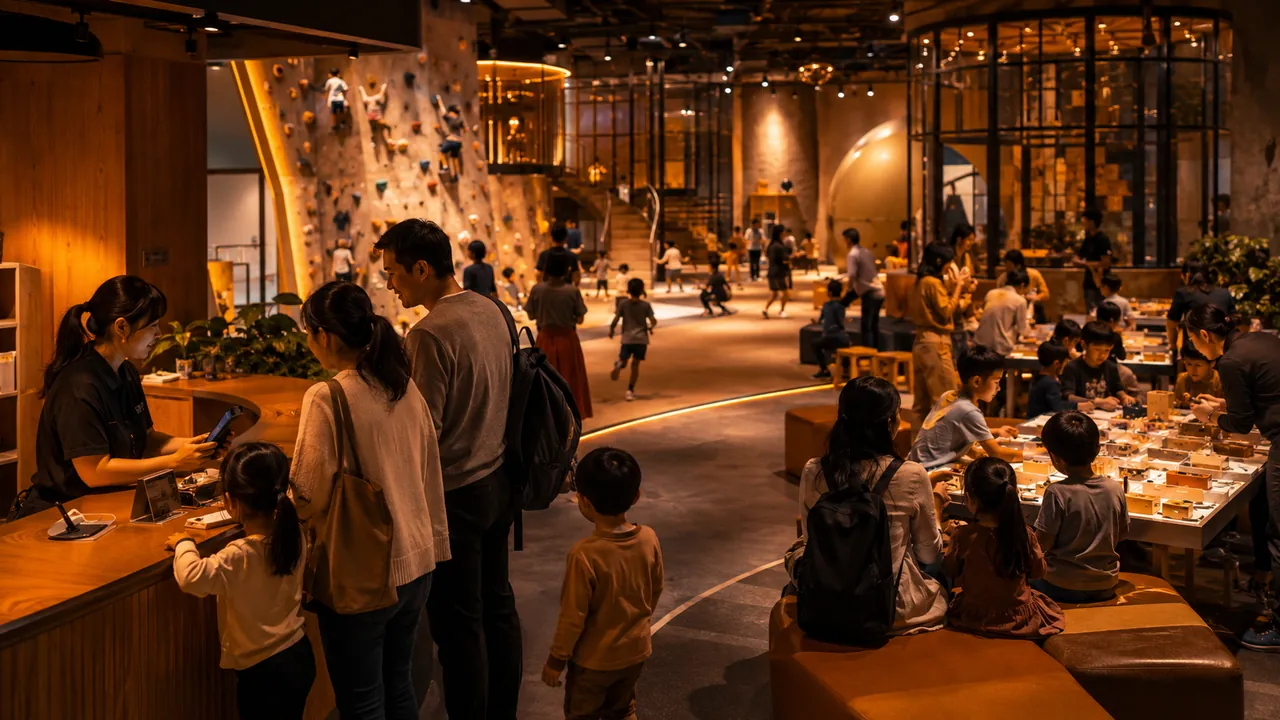
WHOLE FAMILY

The Passive Parent Problem

Many activity parks are designed around a simple assumption: children play while parents wait. Better family entertainment should create value for both sides of the family.

Read the original article in PDFReturn to Research Library
The Passive Parent Problem — Future Experience Research

A typical family entertainment park devotes most of its space and creativity to children. Parents pay, supervise, wait, manage siblings, and eventually decide whether another visit is worth the time and money.

This creates a significant gap.

Comfortable seating, reliable Wi-Fi, charging, good coffee, adult-friendly food, useful work surfaces, better acoustics, and clear sightlines can immediately improve the parent’s experience. Waiting is part of the customer experience, even when the parent is not using an attraction.

But simply building a better waiting lounge does not completely solve the problem.

Parents should have several legitimate choices. They may want to relax, work, observe, participate, socialize, or understand what their child is accomplishing.

Most importantly, some experiences should allow parents and children to co-create.

They might build something, design a game, solve a challenge, compete as a team, produce a family video, create a story, or develop a project together. This is different from simply standing beside a child while the child plays.

Participation should never be mandatory. Sometimes the best experience for a parent is drinking coffee while the child plays independently. The important principle is choice.

A successful family entertainment park therefore needs more than child satisfaction. Parents must also believe the experience is safe, comfortable, worthwhile, and worth repeating.

Read the original article in PDFReturn to Research Library
FEC GAPS

What Existing FECs Leave Unresolved.

Our FEC Gap Taxonomy identifies recurring weaknesses across traditional family entertainment. These six structural gaps are especially important to repeat visitation, family value and long-term engagement.

01

Novelty & Repeat Visitation

Static attractions lose novelty. Changing themes, missions, programs, levels and events create new reasons to return.

02

Personalization & Progression

The same experience for every child limits relevance. Profiles, interests, recommendations, saved projects and levels make later visits more personal.

03

Social Connection

Activity without belonging is easy to replace. Clubs, teams, competitions and community programming create social reasons to return.

04

Parent & Whole-Family Value

Parents too often wait, supervise and pay. Better concepts let adults relax, work, observe, connect, participate and understand the value.

05

Developmental Value

Entertainment can do more than occupy time. Movement, thinking, creativity, problem-solving and visible outcomes can be embedded in play.

06

Technology & Digital Continuity

Technology should support creation, personalization, feedback and continuity — not simply add more passive screen time.

HOW THE RESEARCH WORKS

Research Through Real Questions, Prototypes and Evidence.

We move from identifying a problem to testing a practical response, observing what families and markets actually do, and improving the strategy based on evidence.

01

Identify the Gap

Define a recurring weakness, unmet need, market question or operating problem.

02

Build a Hypothesis

Describe what change may create a better customer, market or business outcome.

03

Design the Test

Turn the hypothesis into a prototype, research design or practical experiment.

04

Observe & Measure

Study behavior, feedback, engagement, demand and other relevant outcomes.

05

Interpret

Compare what happened with what was expected and identify what matters.

06

Improve

Refine the concept, strategy or operating model and repeat the cycle.

CONTACT

Conduct Research.
Develop Strategy.
Make It Better.

Improving an existing FEC, developing a new activity park, revitalizing a shopping mall, developing multifamily housing, evaluating a market, or testing a new concept? Let's discuss.