FUTURE OF FEC

The Family Entertainment Park of the Future

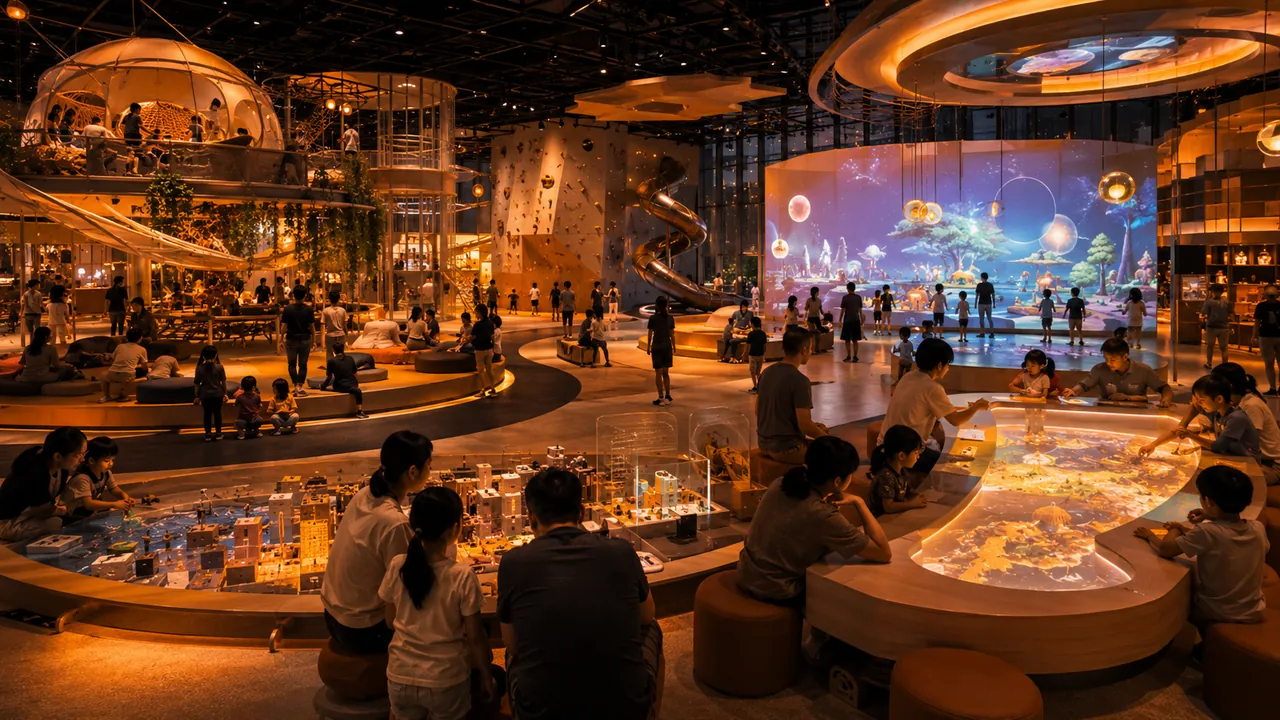
The next generation of family entertainment parks will not be defined by more screens, robots, or futuristic decoration. The real transformation is from a fixed attraction venue into an adaptive family experience platform.

Read the original article in PDFReturn to Research Library
The Family Entertainment Park of the Future — Future Experience Research

The family entertainment park of the future is not defined by neon lighting, robots, virtual reality, or science-fiction decoration. Those elements may be useful, but a venue remains traditional if families encounter essentially the same static experience every time they visit.

A more fundamental change is to treat the park as an adaptive family experience platform. Physical play remains central, but it is connected with exploration, creation, skills, social interaction, parent-child participation, progression, changing programming, and continuity across visits.

Physical attractions can become more adaptive through different difficulty levels, personal records, team missions, changing targets, responsive environments, and age-appropriate routes. Familiar equipment can support many different goals instead of one fixed use.

Exploration can move into science, space, energy, cities, transportation, oceans, media, data, professions, food, or economics. Creation can turn those topics into games, books, music, film, designs, robots, inventions, products, businesses, or shared projects.

The critical distinction is agency. Children should not only receive content. They should make choices, build, test, improve, collaborate, and create visible outcomes.

Later visits should also be able to become more personal and advanced than earlier ones. Profiles, saved projects, levels, achievements, recommendations, and next challenges can preserve continuity without making the experience dependent on passive screen time.

Programming is another part of the operating system. Weekly clubs, monthly themes, competitions, showcases, seasonal missions, community programs, and major events can continuously refresh the reason to visit without rebuilding the entire park.

Parents are part of the platform too. They may relax, work, observe, participate, connect, and understand what their children are accomplishing. Strong family value requires both child excitement and parent approval.

The future is therefore not a look. It is a system that can adapt, learn, refresh, and create progressively meaningful experiences for children and families.

Read the original article in PDFReturn to Research Library
FEC GAPS

What Existing FECs Leave Unresolved.

Our FEC Gap Taxonomy identifies recurring weaknesses across traditional family entertainment. These six structural gaps are especially important to repeat visitation, family value and long-term engagement.

01

Novelty & Repeat Visitation

Static attractions lose novelty. Changing themes, missions, programs, levels and events create new reasons to return.

02

Personalization & Progression

The same experience for every child limits relevance. Profiles, interests, recommendations, saved projects and levels make later visits more personal.

03

Social Connection

Activity without belonging is easy to replace. Clubs, teams, competitions and community programming create social reasons to return.

04

Parent & Whole-Family Value

Parents too often wait, supervise and pay. Better concepts let adults relax, work, observe, connect, participate and understand the value.

05

Developmental Value

Entertainment can do more than occupy time. Movement, thinking, creativity, problem-solving and visible outcomes can be embedded in play.

06

Technology & Digital Continuity

Technology should support creation, personalization, feedback and continuity — not simply add more passive screen time.

HOW THE RESEARCH WORKS

Research Through Real Questions, Prototypes and Evidence.

We move from identifying a problem to testing a practical response, observing what families and markets actually do, and improving the strategy based on evidence.

01

Identify the Gap

Define a recurring weakness, unmet need, market question or operating problem.

02

Build a Hypothesis

Describe what change may create a better customer, market or business outcome.

03

Design the Test

Turn the hypothesis into a prototype, research design or practical experiment.

04

Observe & Measure

Study behavior, feedback, engagement, demand and other relevant outcomes.

05

Interpret

Compare what happened with what was expected and identify what matters.

06

Improve

Refine the concept, strategy or operating model and repeat the cycle.

CONTACT

Conduct Research.
Develop Strategy.
Make It Better.

Improving an existing FEC, developing a new activity park, revitalizing a shopping mall, developing multifamily housing, evaluating a market, or testing a new concept? Let's discuss.